
Do African American Hair Transplants Work?
Hair transplants work for all types of hair, including African American hair. African American hair is unique in many ways, which leads to misconceptions about hair loss treatment. While its texture ranges from fine to coarse, its curl patterns vary from straight to extremely tight and it boasts a broad range of shades and hues, African American hair can still fall out like any other hair.
With the effects of advancing age and certain diseases, hair loss is a common problem among Black men and women. As a person of color, you require the best hair replacement surgeon for a hair transplant, due to the curly nature of your hair type. But African American hair transplant techniques offer a solution for the distressing issue that affects adults from as early as their 20s.
Dr. Gary Linkov, a board certified surgeon at Linkov Hair Surgery in New York City, can perform a hair transplant for African American men and women of all ages. One of the top hair transplant surgeons for African Americans, Dr. Linkov uses an advanced approach for the safest and most effective hair loss treatments for men and for women.
Patient Experience

What Are the Special Considerations for Black Men Hair Transplants?
If your once full head of hair has started to thin, a hair transplant is an effective, permanent solution. Find a hair replacement specialist with experience in Black hair transplants who considers multiple factors, including:
- Donor hair density issues The donor area density for African American hair isn’t that thick. Luckily, the curly nature of the hair boasts a higher volume
- Careful excision of donor tissue The kinky and curly nature of Black hair may complicate the spacing during excision. The curling below the skin means the surgeon needs a wider donor area to get the same number of follicles or individual follicle units required for a successful transplant
- Grafting concerns Your surgeon has to be careful not to cause transection of the donor hair follicle, which happens when the scalpel cuts the hair bulb at its base. If that happens, the transplanted hairs may not grow successfully
At Linkov Hair Surgery, the doctors and staff have worked with African American patients for years. Through training and experience, these hair restoration professionals have built a reputation as the go-to facility for a NYC hair transplant for Black males and females.

What Are the Options for Hair Transplants for African Americans?
After an assessment at your initial consultation, the top hair restoration surgeon in Manhattan determines the best technique for a hair transplant for an African American man or woman. The two most common techniques include:
Follicular unit extraction In the FUE hair restoration technique, the surgeon extracts individual follicles from the donor area on your head, usually the back or side, and transplants the follicles to the recipient area, where you need more hair
Follicular unit transplantation For the FUT hair transplant technique, your hair restoration professional extracts a strip of individual follicle units, from one to four inches long. In this strip method, the surgeon removes follicles from the strip and grafts them into the recipient area
Each of these procedures has benefits and drawbacks, so you and your hair surgeon decide the best approach during your consultation. Dr. Linkov explains the options for the best African American hair transplant for you. No matter which you choose, the goal is still the same: to add hair volume where you most need it.
Before and After Gallery Shots
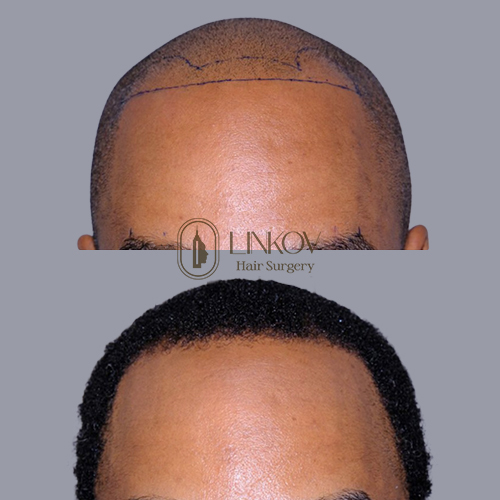
This kind patient was interested in a slight lowering of his hairline and improved hair density in his frontotemporal areas. We made sure that he was stable on medical therapy prior to surgery. A total of 1550 FUE grafts (single session) were transplanted.
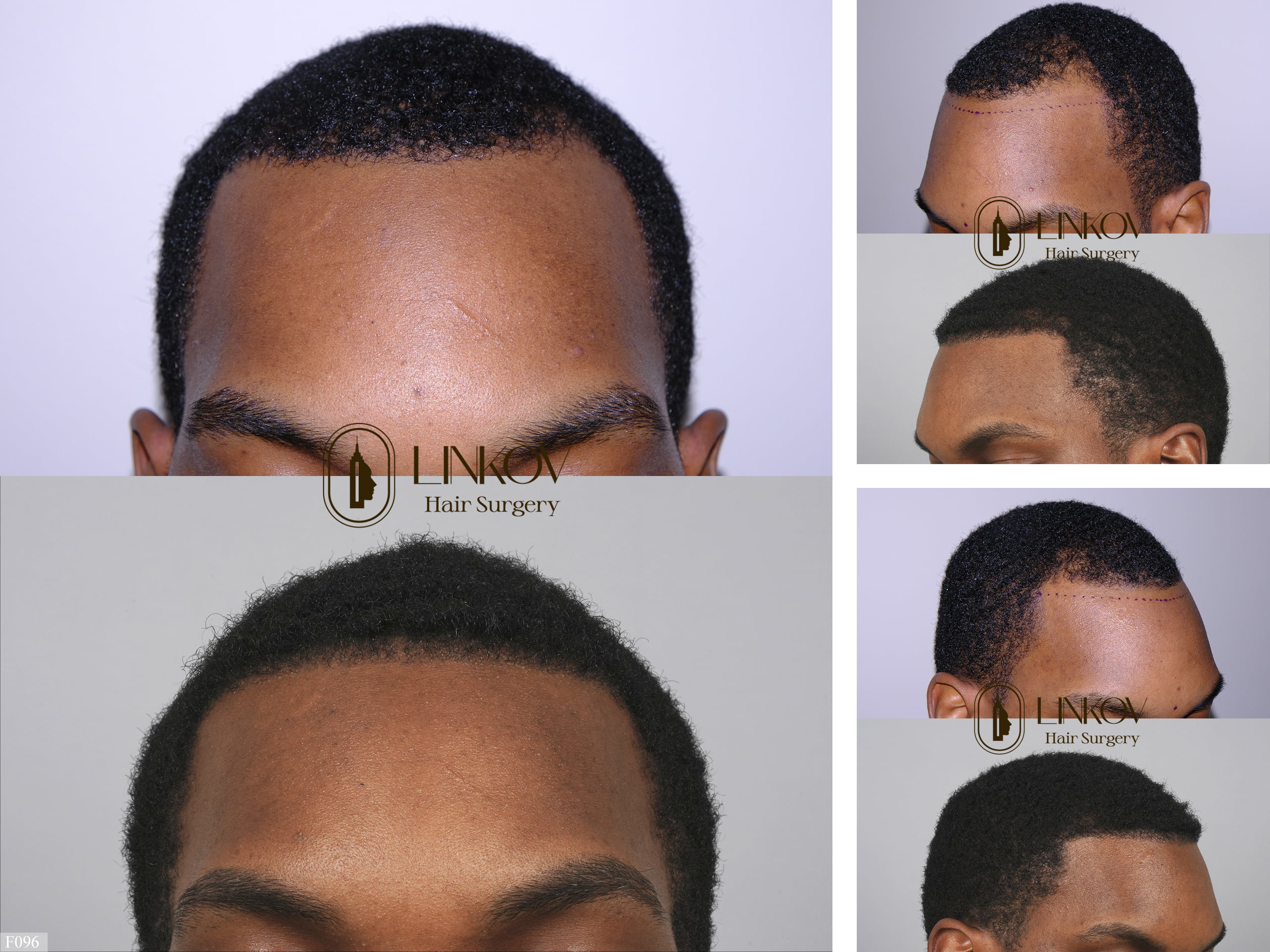
10 months after 1954 FUE hair transplant (single session) to the hairline and temples. This natural result has allowed the patient to feel more confident and less dependent on hats! Though the hair length is different between the before and afters, you can see the transformation and also the density still available at the donor area.
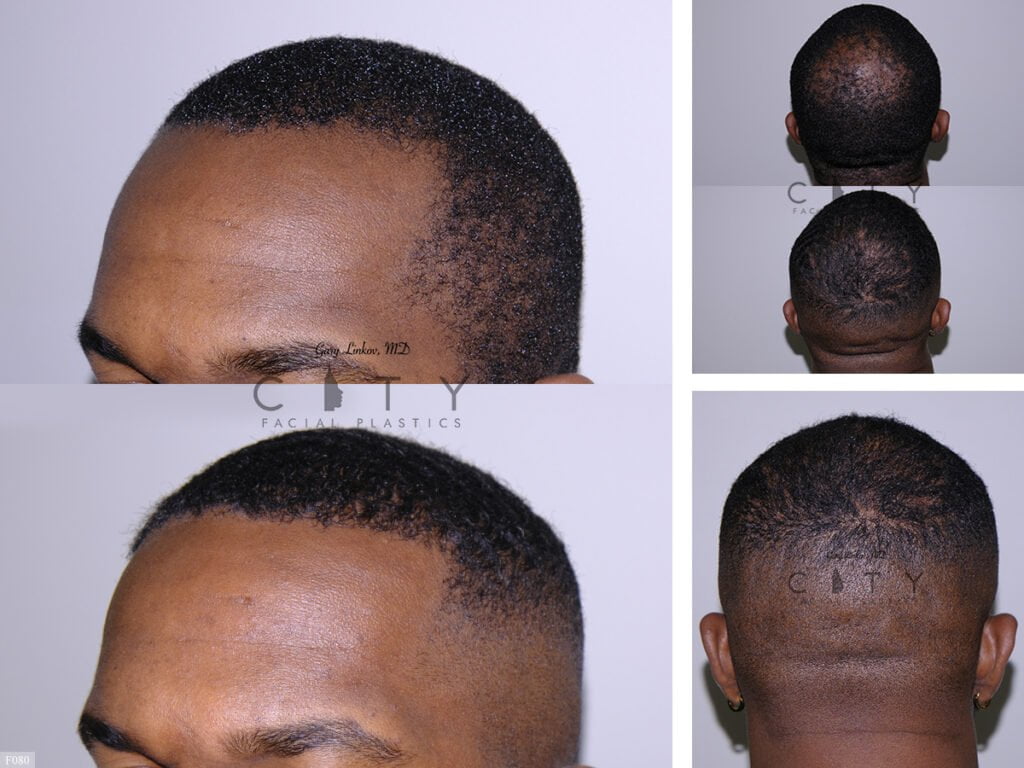
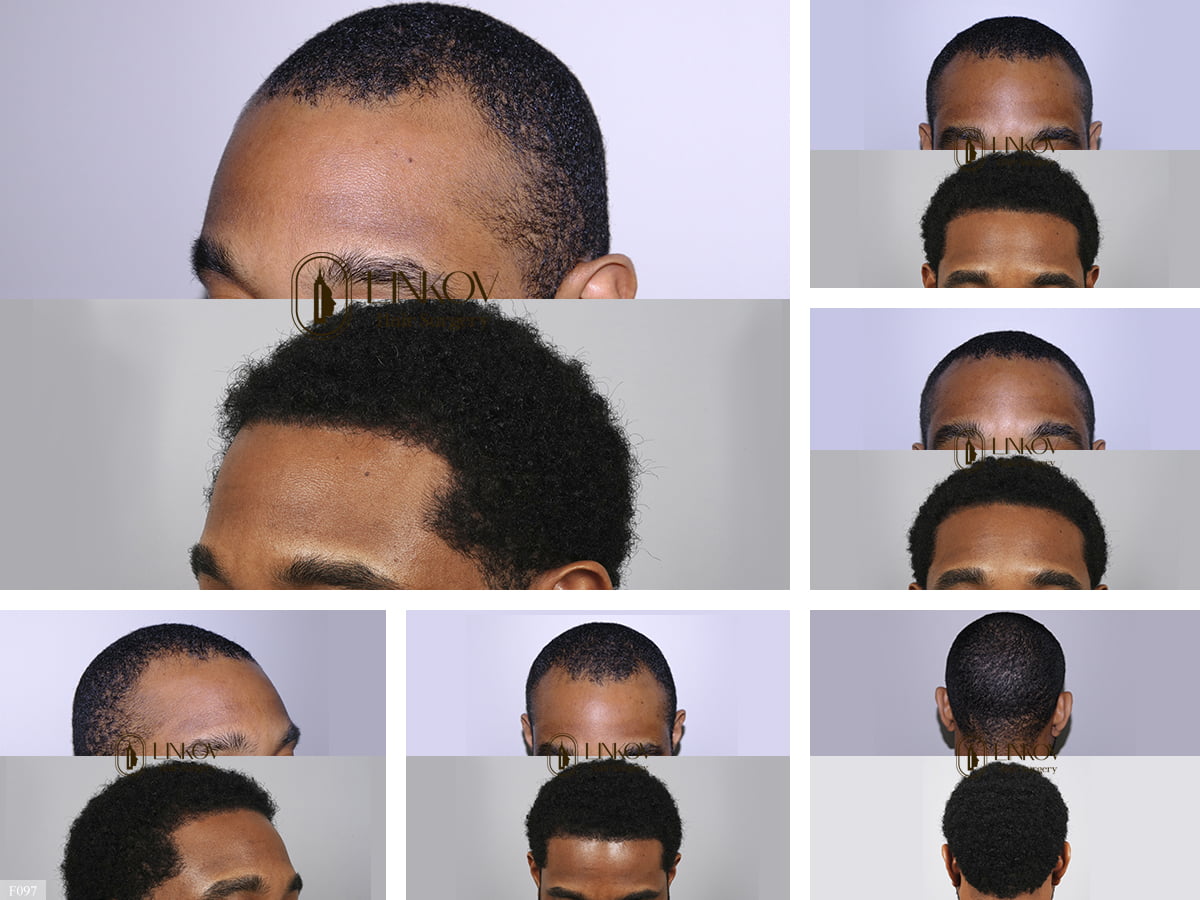
1 year post 2050 FUE hair transplant (single session) to the hairline and crown, with about an even split between the two recipient areas. We made excellent progress with one surgery, and he plans on returning for additional grafting in the future to further increase density. Notice the donor area in the postop image, the scarring is nearly impossible to detect with the naked eye.
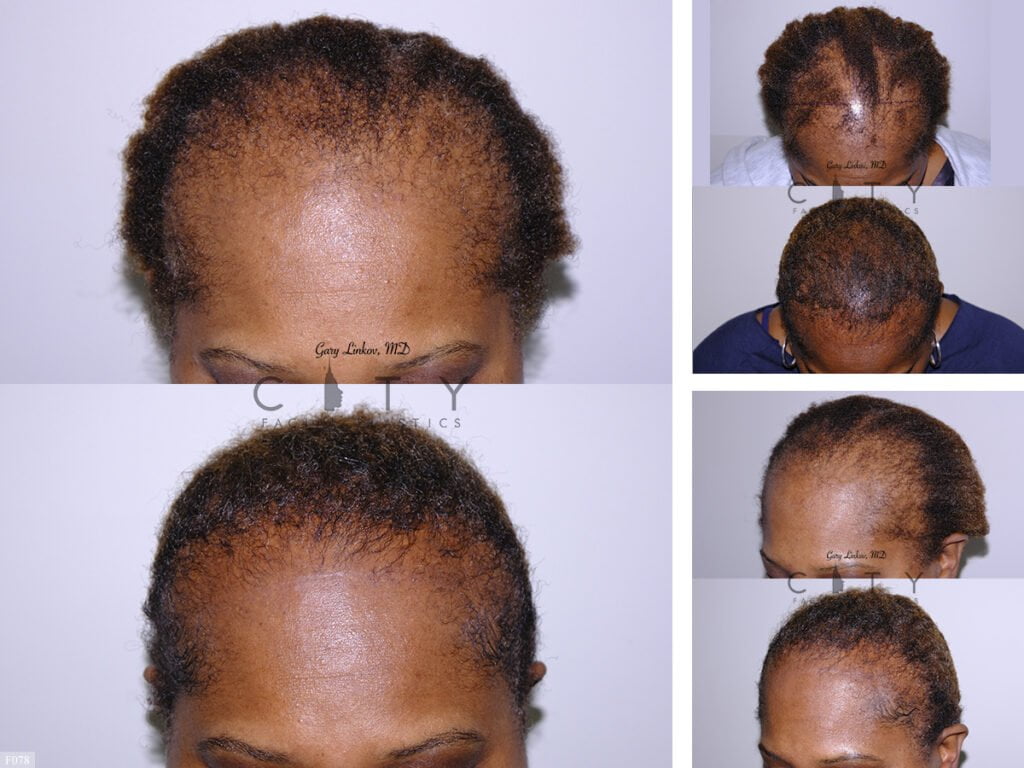
1 year post 1500 FUE hair transplant (single session) to posterior frontal scalp and midscalp. She has a history of scarring alopecia, so we previously did a small test procedure (50 grafts) for her with good regrowth. That gave us the confidence to proceed with a larger procedure. We purposfully kept the recipient area coverage conservative to improve density where it mattered most to her.
What Are the Benefits of an African-American FUE Hair Transplant?
Hair loss is distressful at any age and for any gender. If you’ve noticed your curly hair thinning, consult the best hair restoration expert for African American hair. Some benefits that come with an African American FUE hair transplant include:
- It’s a minimally invasive hair transplant procedure with reduced risks.
- A hair transplant for African Americans using the FUE technique is often less invasive, compared to other forms of hair restoration
- The hair restoration procedure is done with local anesthesia to numb the surgery area
- There’s minimal downtime because of the reduced scarring and risk of complications
- Recovery is faster and you can go back to work right away, although your doctor may recommend rest for a few days
- You enjoy minimal discomfort due to the local anesthesia
Your hair restoration professional leverages the advantages to give you the most natural look after the hair loss treatment. An experienced hair restoration professional like Dr. Linkov uses the latest FUE hair transplant techniques to give you the best results possible
What’s the Process Involved in an African American Hair Transplant?
Every African American man or woman has unique hair loss challenges, and your doctor determines the best approach after an assessment and diagnosis of the cause of your hair loss. While every procedure may differ slightly, you can expect the primary steps in a normal hair transplant to include:
Diagnosis If you have an underlying medical condition causing your hair loss, your doctor knows that you must treat them first, which may solve your hair loss issues. Otherwise, a treatment plan can be formed from your specific diagnosis.
Donor hair availability Your doctor checks the available hair reserve on the back and sides of your head to determine if a hair transplant is viable. Then, the best technique can be decided on.
Preparation Before your procedure, you must stop smoking, drinking and using blood-thinning drugs. Your doctor may advise you further on how to prepare for the surgery.
Hair restoration African hair is delicate, so the surgery may be challenging and require special care. Using the latest medical technology, your hair replacement surgeon uses either the FUE or FUT technique to transplant hair where you want it. This hair restoration surgery provides permanent hair replacement.
At Linkov Hair Surgery, you have the top hair transplant surgeons for African Americans available. The African American hair transplant cost varies, depending on your individual requirements, the experience of the surgeon and your location. Contact the best hair transplant surgeons for African Americans in New York City today to start the process toward looking younger with a full head of hair.
Linkov Hair Surgery
150 E 56th St, #1A
New York, NY 10022
(212) 970-9404