

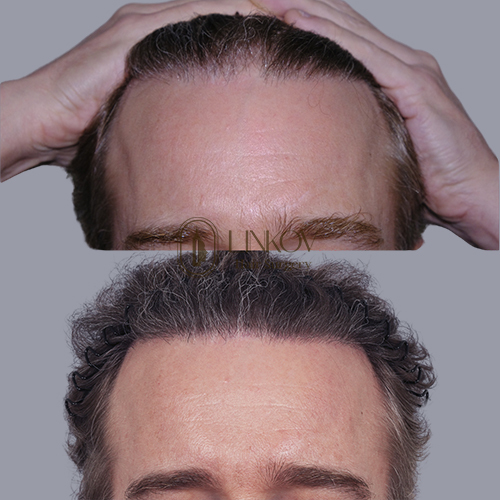
Non-Surgical Options
Medical hair loss therapies are often a first-line treatment for stabilizing a receding hairline, particularly when androgenetic alopecia (male/female patterned hair loss) is the underlying cause.
Popular medical hair loss therapies that can target receding hairlines include:
- Minoxidil
- Finasteride
- Spironolactone (for women only)
These medications work two ways. They stimulate hair growth (minoxidil) to improve density and help preserve remaining hair by blocking dihydrotestosterone (DHT), the hormone responsible for androgenetic patterned loss. These are considered the gold standard of non-surgical hair loss therapy.
Other nonsurgical treatments that can be added or performed alone to stimulate hair growth and decrease inflammation include low-level laser therapy (LLLT) and regenerative treatments, such as PRP and exosomes.
Non-surgical approaches work best when started early and used in combination consistently. Results take time, improving recession visibly over 3-6 months.

Surgical Solutions
For more advanced recession, hair transplants can offer permanent restoration of the hairline. FUE or FUT techniques create natural-looking results that can last a lifetime.
A surgical hair transplant can:
- Recreate a youthful hairline
- Fill in temple corners
- Deliver long term improved density
Results from a hair transplant mature with final results becoming visible at 9-12 months.
Hairline Advancement Surgery
Hairline advancement surgery (also known as forehead reduction or hairline lowering surgery), is a cosmetic surgical procedure used to physically lower a high hairline and reduce the overall height of the forehead.
For the right candidate, this can be an option to address their hairline recession.
During hairline advancement surgery, Dr. Linkov removes a strip of skin from the upper forehead and pulls the hair-bearing scalp forward, securing it in a lower position to create more balanced facial proportions.
Which Option Fits You?
Your best treatment plan to address a receding hairline will depend on recession stage, age, and goals. Early recession (Norwood 1-2) can respond well to non-surgical methods, whereas more advanced recession may respond better to a combination of medical therapy, non-surgical treatments, and surgery.
Medical hair loss therapy and non-surgical options are a good place to start if:
- Your hair loss is mild
- You prefer a non-invasive start
Surgery can often benefit patients who:
- Have more extensive hair loss
- Have stabilized their hairline
- Have already tried non-surgical options such as medical therapy
No two hair loss treatment plans are the same. Bespoke, combination approaches often yield the best outcomes.
Start Your Hairline Restoration Today
Determining the best strategy to address your hair loss begins with a consultation where Dr. Linkov can evaluate your hair loss, assess your donor supply, and help develop a plan.
Linkov Hair Surgery
150 E 56th St, #1A
New York, NY 10022
(212) 970-9404