

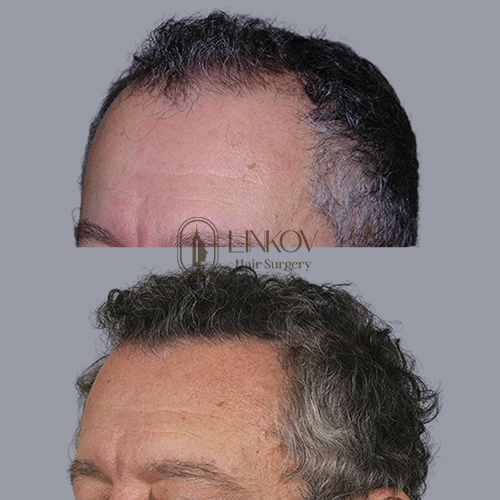
What Is Involved in Hair Transplant Surgery Recovery?
Right after surgery, the focus of care is on protecting your grafts, managing residual swelling, and allowing your donor and recipient areas to heal. In the first week, redness, scabbing, itching, sensitivity, and tightness can be common. It is important to avoid touching and/or scratching your scalp during this phase. Your surgical team will go over how to clean your grafts safely before and after surgery.
As healing progresses past the first few weeks and months, shedding of the transplanted hairs will occur. This is a normal part of the healing journey and expected. New growth starts after the transplanted follicles re-enter the growth phase (anaphase). Stimulating regenerative treatments can be introduced at appropriate times to optimize this regrowth phase.
A typical recovery timeline often proceeds like this:
- Days 1 to 7: redness, swelling, scabbing, and careful aftercare.
- Week 2: shedding begins as the scalp settles.
- Weeks 3 to 4: healing continues; shedding continues.
- Months 3 to 4: early new growth can be seen.
- Months 5 to 6: noticeable density improvements.
- Months 9 to 12: final results become visible.
- 1 Year: Subsequent procedures can be planned if desired.
Shedding, patchy early growth, and uneven progress during the first several months is a normal part of hair transplant recovery.

What Factors Affect my Recovery Timeline?
Recovery can vary depending on the exact procedure performed (FUE or FUT), the size of the transplant recipient area (brows, versus beard, versus scalp), and whether aftercare instructions are followed. Lifestyle factors, scalp health, and individual biology can also influence healing and hair growth.
Early growth may look fine or uneven at first, then becomes thicker and more natural as the months pass. Hair transplants begin to look more complete around the 6-month mark, with final results taking up to a year or more.
Patients who follow instructions carefully and protect the scalp during the early phase of recovery will give their hair transplant the best chance of succeeding. Remember, it’s a gradual process and requires patience.

Hair Restoration Begins with a Consultation
Understanding the hair transplant recovery timeline helps set your expectations and anticipate the healing journey ahead of you. With the right aftercare and patience, you’ll be seeing your final results before you know it.
The best way to know whether a hair transplant is worth it is to get a personalized assessment. During a consultation, Dr. Linkov can evaluate your hair loss, assess your donor supply, and align expectations. For the right patient, a hair transplant can absolutely be the natural looking and confident solution to their hair loss.
Linkov Hair Surgery
150 E 56th St, #1A
New York, NY 10022
(212) 970-9404